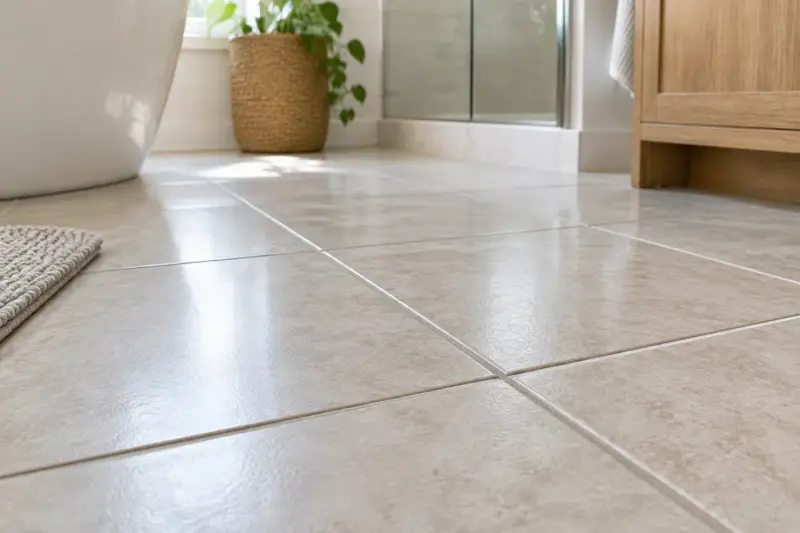
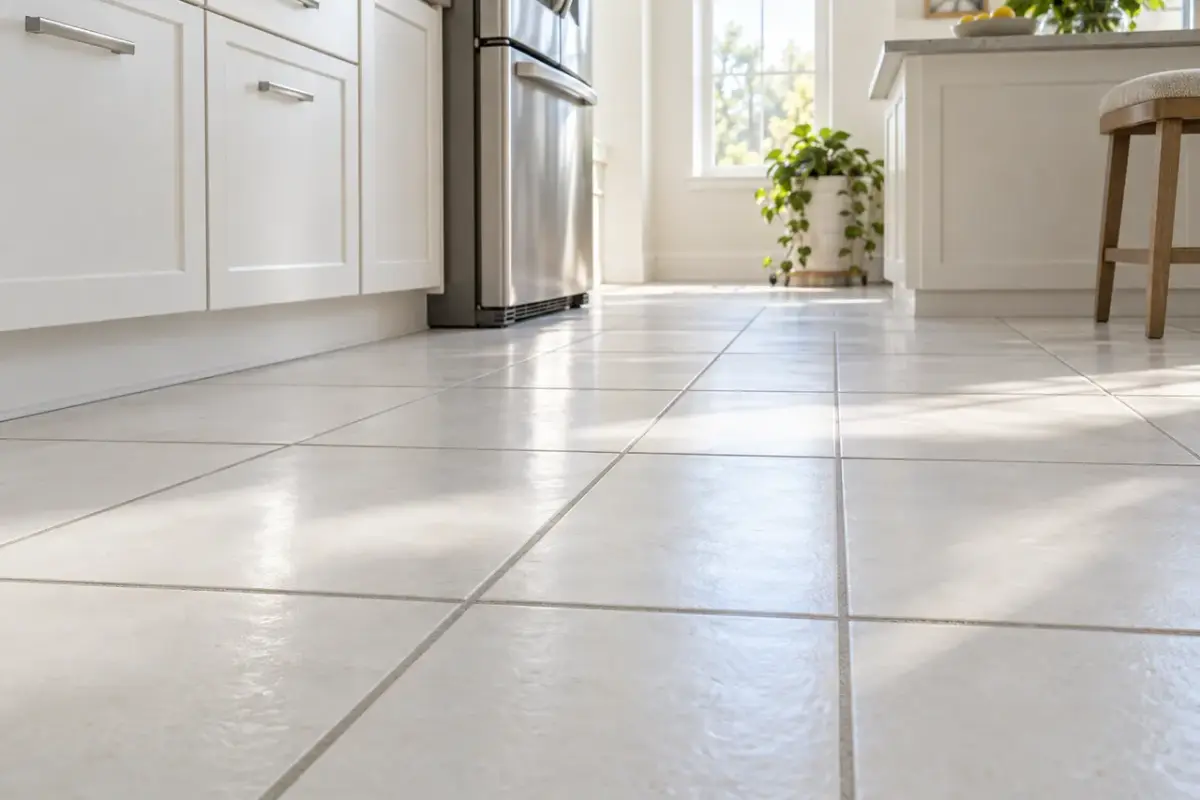
Often, yes. If the grout is dark because of soil, a deep cleaning brings much of the original color back. Grout that has gone from white or light gray to dark gray is usually holding soil, cooking oil and dried mop water in its pores, and a cleaning that rinses with hot water and extracts the dirty water lifts a lot of it out.
It won’t come back white if the grout was never white, if a stain has soaked deep into the grout itself, or if the surface has worn away. A few minutes of checking will tell you which you have before you spend money on cleaning, a colorant or new grout.
What color was your grout originally?
This is the most useful check, and it takes a minute.
Find grout that nobody walks on and that the mop rarely reaches: the strip right against the wall, the corner behind the toilet, under the edge of the cabinet toe kick, inside a closet, or under a rug that has been in place for years. That grout has collected far less soil than the open floor.
- If the hidden grout is light and the open floor is dark, the difference is mostly soil, and cleaning has a good chance of closing much of the gap.
- If the hidden grout is as dark as the rest, that’s probably its original color, or it was colored at some point. Cleaning won’t make it lighter.
Keep in mind that a lot of grout sold as “white” or “bright white” was never as white as the tile next to it, and plenty of floors were grouted in a light gray or beige. Cleaning brings back the grout’s color, not the tile’s.
What can cleaning restore, and what can’t it?
| What you see | Likely cause | Will cleaning help? | Who handles it |
|---|---|---|---|
| Even gray darkening, worst in walkways and the mop’s path | Soil and dried mop water in the pores | Usually a big improvement | Tile and grout cleaning |
| Dark, slightly tacky lines near the stove and sink | Cooking oil holding soil | Usually improves well | Tile and grout cleaning |
| Dark blotches in one spot: wine, coffee, pet urine, rust, hair dye | A stain absorbed into the grout | Sometimes; old or deep stains may stay | Clean first; colorant if a stain remains |
| A yellow cast on older grout | Often bleach used over the years | Removes soil, not the yellowing | Colorant or regrouting |
| Rough, sandy lines sitting below the tile | Worn surface exposing the sand | Cleans up, then darkens again faster | Regrouting, by a tile contractor |
| Cracked, crumbling or missing grout | Physical damage | No | Regrouting, by a tile contractor |
| Hidden grout just as dark as the rest | Original or added color | No | Colorant, if you want a change |
Most kitchen and bathroom floors are a mix. The open floor improves a lot, a few old stains stay faint, and some lines in the busiest path are worn. We’d rather tell you that before we start than have you expect every line to match.
Why does grout look darker than it really is?
Because the contrast does most of the damage. Grout sits slightly lower than the tile, so spills and mop water run into it, and it’s porous, so it soaks them up. Light grout next to clean, glazed tile shows every bit of that. Our guide to why grout looks dirty again so soon after cleaning explains how mopping and some household cleaners make it worse.
That also means bleach, vinegar and scouring powder aren’t the shortcut back to white they seem to be. Bleach can leave old grout yellow, acids roughen cement grout, and abrasives wear it down, and each of those makes the grout darken faster afterward.
What are grout colorants, and when do they make sense?
A grout colorant, sometimes sold as grout stain or grout paint, is a tinted coating brushed onto clean grout lines to give them one even color. It’s the usual answer when cleaning gets the grout clean but not even: a few stains that won’t lift, a patchwork of old repairs, or grout that was simply never the color you want.
What to know before choosing one:
- It needs clean, dry grout. Colorant applied over soil doesn’t bond well and seals the soil underneath. Cleaning comes first.
- It’s a coating. In walkways and in front of the sink, it can wear, and on poorly prepared grout it can peel.
- It’s slow, careful work. Every line, by hand, without getting it on the tile.
We clean grout, but we don’t apply colorants or sealers. A tile contractor or a grout restoration company can, and some homeowners do it themselves following the product’s directions. If you plan to use one, have the floor cleaned first and let it dry fully.
When is regrouting the answer?
When the grout itself is failing: cracked, crumbling, missing in places, or worn so far below the tile that it collects soil no matter what you do. Regrouting means removing old grout and packing in new, and it’s usually a tile contractor’s job.
Cleaning first still helps the decision. A floor that looked like it needed new grout sometimes only needed the soil out, and if it does need regrouting, you’ll know which areas.
How do you keep cleaned grout from darkening again?
- Mop with clean water, change it often, and use as little as gets the job done.
- Use a pH-neutral floor cleaner sparingly, and skip bleach, vinegar and abrasive powders.
- Wipe kitchen spills, especially oil, right away.
- Put mats at exterior doors to catch grit before it reaches the tile.
- If you want the grout sealed, have it done right after a deep cleaning, once the grout is dry. Sealing slows absorption, though it doesn’t make grout stain-proof.
When should you call a professional?
Call when the hidden-grout check says your grout started out lighter than it looks now, when mopping no longer changes anything, or before you buy a colorant or get a regrouting quote. We’ll look at the floor with you, point out which areas we expect to respond well and which we think are permanent, and then clean it: a solution matched to the grout, time for it to loosen the soil, a brush suited to grout, then a hot-water rinse with the dirty water extracted to the truck.
We clean ceramic and porcelain tile, not natural stone. If you’re not sure which you have, text a photo first.
Text a photo of the worst area and one of a hidden corner to (626) 260-6256, or call (800) 794-9241. We’re based in West Covina and clean tile floors across the San Gabriel Valley, including older homes with their original tile in Hacienda Heights and Glendora. More at tile and grout cleaning.