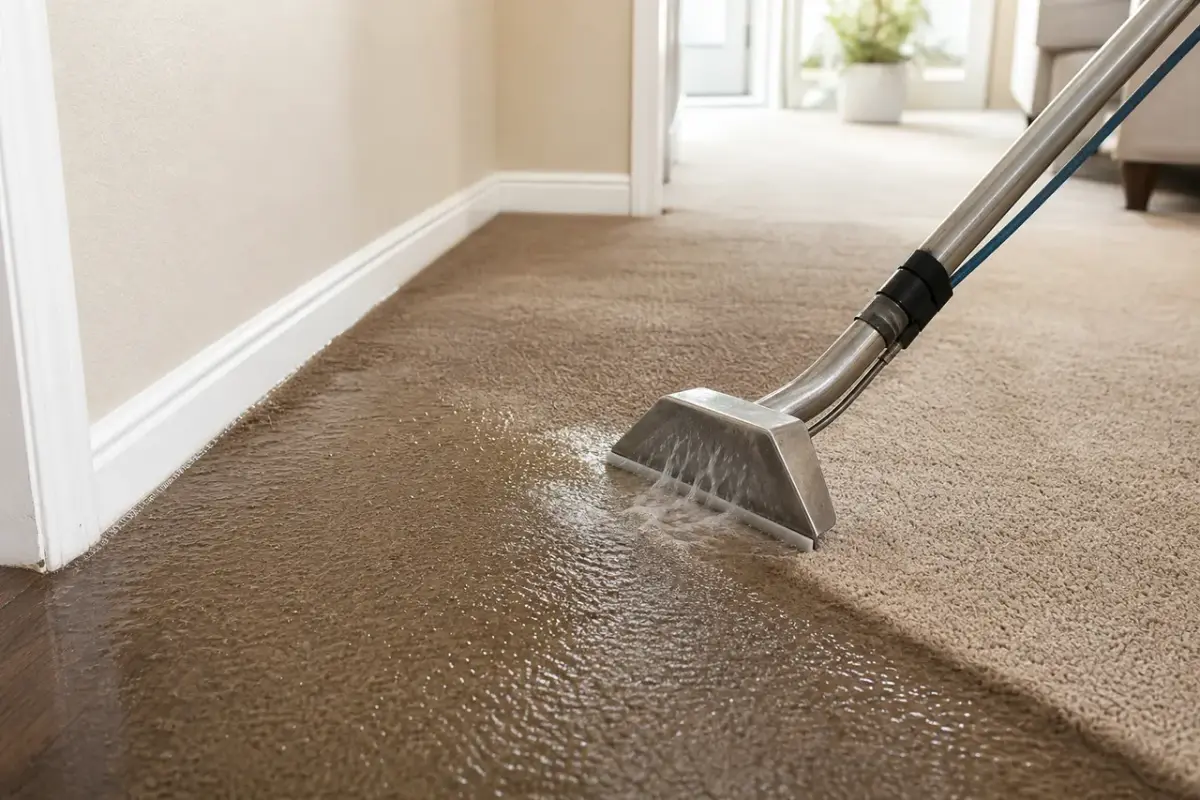
Carpet soaked by a burst pipe, a leaking water heater, or an overflowing tub? Call (800) 794-9241 for emergency water extraction. We answer 24 hours a day, 7 days a week. Buyher’s Carpet & Upholstery Cleaning is a family-owned, licensed and insured company based in West Covina, and for more than 38 years we’ve come to homes and businesses across the San Gabriel Valley. On a water call, we extract as much water as we can from your carpet and the pad underneath it, then bring drying fans and set them up so the floor can dry.
You can also text a photo to (626) 260-6256. A picture of the wet area and where the water came from tells us more than a long description, and it lets us tell you what to expect before we arrive. If water is still coming in, start with what to do before we arrive.
Water on the floor right now?
Four quick taps and you'll see what to do first. Or skip them and call now: we answer day and night.
Question 1 of 4
Is water still coming in?
Where is it coming from?
How many rooms are wet?
Is the power still on near the wet area?
What to do right now
Do
- Turn off the water: close the shutoff valve on the fixture or appliance, or shut off the main if you can't find it.
- If water is near outlets or cords, switch off the breaker for that area, but only if you can reach the panel without standing in water.
- Move furniture, rugs and anything with dye in it off the wet carpet, or slide foil or plastic under the legs.
- Take photos of the water and where it came from before you clean anything up, for your insurance.
- Call (800) 794-9241 and tell us where the water came from, how long it's been there and how many rooms it reached.
Don't
- Don't use a household vacuum or a carpet shampooer on the water.
- Don't walk through water near live outlets, cords or plugged-in appliances.
- Don't touch or clean up sewage or floodwater from outside yourself; keep children and pets away from it.
- Don't wait to see whether it dries on its own. The pad holds water against the floor.
Where the water came from decides what can be saved. Clean water from a pipe or water heater, caught early, is the best case. After a washing machine or toilet overflow the pad usually has to be replaced, and carpet and pad soaked with sewage or floodwater from outside usually have to be removed.
Step by step: what to do in the first 10 minutes of a flood, and how our water extraction works.
Quick facts
Water Extraction
- Method
- Water extracted from the carpet and the pad under it
- Drying
- Drying fans set up; a clean-water leak often dries in 1 to 3 days
- Booking
- Phone answered 24/7; we'll tell you when we can get there
- Area
- West Covina and the San Gabriel Valley
- Quote
- Free and upfront, no hidden fees. Text a photo to (626) 260-6256
- Not offered
- Carpet or pad replacement, and mold remediation
On this page
Water emergencies we handle
We extract water from carpet after any of these:
- Plumbing leaks and burst or cracked supply lines
- Water heater leaks and failures (see what to do when a water heater soaks the carpet)
- Sink, tub, and toilet overflows
- Washing machine overflows (see what to do first after a washing machine overflow)
- Roof and storm leaks during winter rain
- Standing water and flooded rooms
Where the water came from matters, because it decides what can be saved; that’s covered below. For a spill, pet accident, or stain rather than water, see emergency carpet cleaning.
What to expect
What happens when you call
We don't promise an arrival time, but we'll tell you honestly when we can get there.
Step 1: Call 24/7
(800) 794-9241 is answered day and night. Tell us where the water came from and how many rooms it reached.
Step 2: Water extraction
We pull as much water as we can out of the carpet and the pad underneath it.
Step 3: Drying fans set up
The fans keep air moving across the carpet while it dries, and we tell you what comes next.
How emergency water extraction works
- You call or text. Tell us where the water came from, roughly how long it’s been there, and how many rooms it reached. We’ll tell you plainly when we can get there, and if the situation needs someone who can reach you sooner, we’ll say so.
- We look at the whole wet area. Water travels farther than it looks, so we check past the visible wet spot before deciding where to start.
- We extract the water. We pull as much water as we can out of the carpet and the pad beneath it, which a shop vac or a stack of towels can’t reach.
- We bring drying fans and set them up. The fans keep air moving across the wet carpet so it dries faster, which lowers the chance of musty odor and mold.
- We tell you what comes next. Whether the carpet needs cleaning, whether the pad looks savable, and whether any part of the job calls for a flooring or restoration company.
Drying wet carpet: airflow and how long it takes
Extraction takes out most of the water. What’s left in the fibers, the pad, and the floor underneath has to dry, and moving air is what carries it away, which is why the fans matter.
How long drying takes depends on how much water there was, how long it sat, whether the pad was soaked, and the weather. As a rough guide, carpet from a clean-water leak that’s extracted the same day often dries in one to three days; a soaked pad over a concrete slab can take longer. A few things help:
- Keep air moving across the carpet until it’s fully dry, with fans pointed across the wet area rather than straight down.
- Leave the air conditioning or heat on. It keeps air circulating and the room at a normal temperature, and air conditioning pulls some moisture out of the air.
- Run a dehumidifier if you own one, with doors and windows closed. On a dry Santa Ana day, open windows can help instead.
- Keep people and pets off the wet area so water isn’t pressed back down into the pad.
Don’t decide it’s dry by touch. Carpet fibers dry first, while the pad can stay wet for days, and that trapped moisture is where a musty smell starts. Our guide on why carpet can feel dry but still be wet explains how to check.
Can your wet carpet and pad be saved?
Often, yes. Two things decide it: what kind of water it was, and how long it sat. As a general guide:
| Where the water came from | What usually happens to the carpet | What usually happens to the pad |
|---|---|---|
| Clean water from a supply line, water heater, sink, or tub, caught quickly | Extracted, dried, and kept | Often extracted and dried in place |
| Gray water from a washing machine or toilet overflow | Extracted, cleaned, and often kept | Replaced in that area |
| Sewage from a sewer line, or outside floodwater | Removed | Removed |
| Any water left for days, or carpet that already smells musty | Less likely to come back | Usually replaced |
Clean water is the best case. Gray water is dirtier, but we extract it the same way, and the carpet is often worth keeping once it’s cleaned. Sewage and outside floodwater are a health hazard, not an ordinary cleaning job; removing carpet and pad that soaked them up is work for a restoration or flooring company, so call and describe what happened.
Time matters too. Clean water picks up soil and bacteria from the carpet as it sits, and after a day or two it acts more like gray water. Carpet or pad that has stayed wet for days, or already smells musty, is less likely to come back.
Cleaning carpet after water damage
Water is rarely clean by the time it has soaked through a carpet. It pulls soil up from the backing and the pad, and once the surface dries that can show up as a dingy patch or a ring. So after the water is out, the carpet usually needs a proper cleaning too. We use the same hot-water extraction as our regular carpet cleaning to rinse out the dirt and residue the water left behind.
If a musty smell hangs on after the carpet looks dry, it usually means the pad or the floor underneath is still wet. Tell us. Covering the smell won’t fix it.
What to do before we arrive
Our flooded carpet guide walks through the first few minutes step by step. The short version:
- Stop the water at the fixture’s shutoff valve or the main, if you can do it safely.
- Cut power to the area at the breaker if water is near outlets or cords, but only if you can reach the panel without standing in water.
- Get things off the carpet. Lift furniture, or slide foil or plastic under the legs so wood stain and rust don’t bleed into the wet carpet. Pick up rugs, boxes, and anything with dye in it.
- Take photos of the water and its source before you clean anything up.
- Don’t use a household vacuum or carpet shampooer on standing water. A wet/dry shop vac on clean water is fine; it just can’t reach the pad.
Wondering whether the carpet and pad are worth saving? The guide covers when wet carpet and padding can be saved.
What we don’t do
We’d rather tell you now than surprise you later:
- Carpet and pad removal or replacement. When either has to go, we’ll say so, and a flooring or restoration company handles it.
- Coverage answers. Only your insurer can say what your policy covers.
- Promised arrival times. Traffic and the job before yours both affect when we arrive, so we give you an estimate, not a guarantee.
What changes the price of water extraction?
Every water call is quoted on what we find, and you hear the price before we start. What moves it:
- How much carpet is wet. One room, or water that ran under a wall into the hall and the next bedroom.
- The pad. Water soaked into the pad takes longer to pull out than water sitting in the carpet.
- The kind of water and how long it sat. Gray water, or water that sat for a while, usually means a proper cleaning after the extraction.
- Stairs and furniture. Wet stairs, and furniture that has to come off the carpet before we can work.
- Access. An upstairs unit, a long hose run from the parking spot, or a gated building.
- Timing. There’s no extra charge for evening or weekend appointments. Same-day jobs are fit around the schedule; if that changes the price, we tell you before we come.
Quotes are free and upfront, with no hidden fees. Call (800) 794-9241, or text a photo of the wet area and where the water came from to (626) 260-6256, and we’ll tell you what we expect the job to involve. Our guide to what changes the cost of carpet cleaning covers the cleaning side of the job.
For homeowners, renters, and property managers
- Homeowners. If a pipe lets go at 2 a.m., someone answers the phone at 2 a.m.
- Renters. Tell your landlord or property manager right away, and take photos. The sooner the water comes out, the better for your belongings and the unit.
- Property managers and landlords. A leak in one unit rarely stays in one unit; a burst supply line at a San Dimas apartment complex soaked the carpet and pad in two. We extract water across units, hallways, and common areas, and tell you which units will need a flooring company afterward. For turnovers and routine work, see rental property carpet cleaning.
- Businesses. Offices and shops can call the same 24/7 number. For regular cleaning, see commercial carpet cleaning.
Water extraction across West Covina and the San Gabriel Valley
We’re based in West Covina, in the San Gabriel Valley of eastern Los Angeles County. West Covina, Covina, Baldwin Park, and La Puente are close by, and we cover the rest of the valley, from Pomona and San Dimas to Glendora and Hacienda Heights.
Local construction changes how water behaves. Most homes here sit on a concrete slab, so water runs sideways under walls and often turns up a room or two away from the leak. The wet area is usually bigger than the visible one. In two-story homes, common in hillside areas like Diamond Bar and Walnut, an upstairs leak can come through the ceiling onto the carpet below. Whatever the setup, call (800) 794-9241 as soon as you find wet carpet.