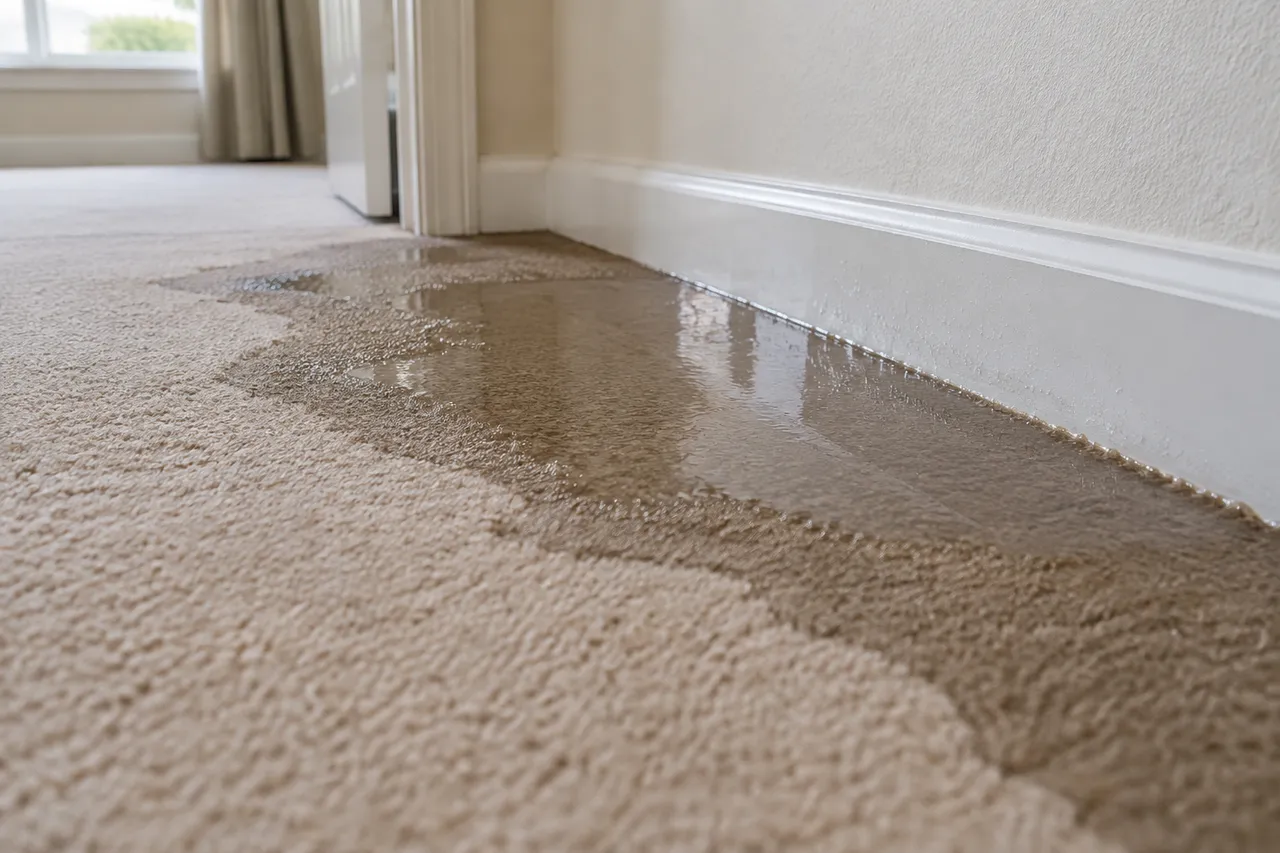
This is the most common way a small water problem turns into an expensive one. Not negligence, not bad luck — just a floor that gives you genuinely misleading information.
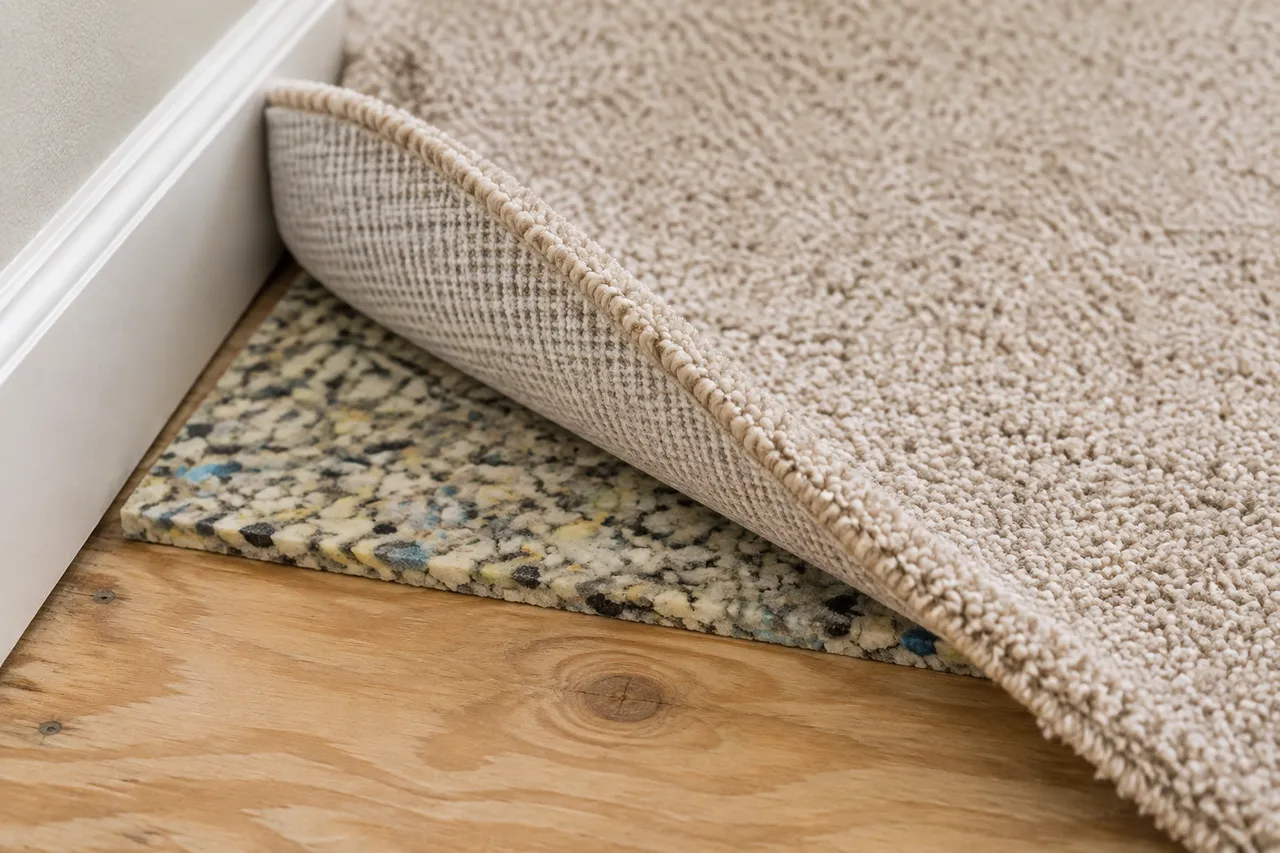
A carpeted floor is three materials, not one
What you walk on is a stack:
- The carpet — face fibers and a backing. Thin, exposed to the room, and in contact with moving air.
- The padding — foam or rebonded chip, typically 7–10mm, deliberately absorbent and compressible.
- The subfloor — a concrete slab in most homes around here, or plywood over joists in older raised-floor houses.
Water does not respect those layers. It passes through the carpet fairly quickly and into the pad, which holds it, and then sits against the subfloor beneath.
Why the top dries first
The face fibers have every advantage. They are on the room side, they have air moving over them, and most modern carpet is nylon or polyester — synthetics that hold much less water than natural fiber. Give them a warm dry day and a fan and they will feel dry to the hand within hours.
The pad has none of those advantages. It is sandwiched between an impermeable-ish carpet backing above and a slab below, in a gap with essentially no airflow. The water in it has nowhere convenient to go.
So the layer you can touch dries fast and the layer holding most of the water dries slowly — or, in an enclosed gap on a slab, barely at all. The floor tells you it is fine. It is not fine.
How you can tell without equipment
None of these is conclusive, but together they are a strong signal:
Press hard with your palm, not your fingertips. Put real weight on it for a few seconds in the middle of the affected area, then feel your hand. Surface-dry carpet over a wet pad often returns moisture under compression when a light touch reveals nothing.
Check the edges and the baseboards. Water migrates outward and wicks up. Carpet at the tack strip and the bottom inch of baseboard or drywall are often the last to dry and the first to show it.
Use your nose in a closed room. Shut the room up for a few hours on a warm day and come back in. Trapped moisture announces itself as a musty smell well before anything is visible, and warmth makes it far more obvious.
Notice whether a smell returns after cleaning. A musty odor that lifts when you clean and comes back a few days later is close to diagnostic. Something below the surface is still wet.
What actually dries it
The short version: air has to reach both sides of the carpet, and sometimes the pad has to go.
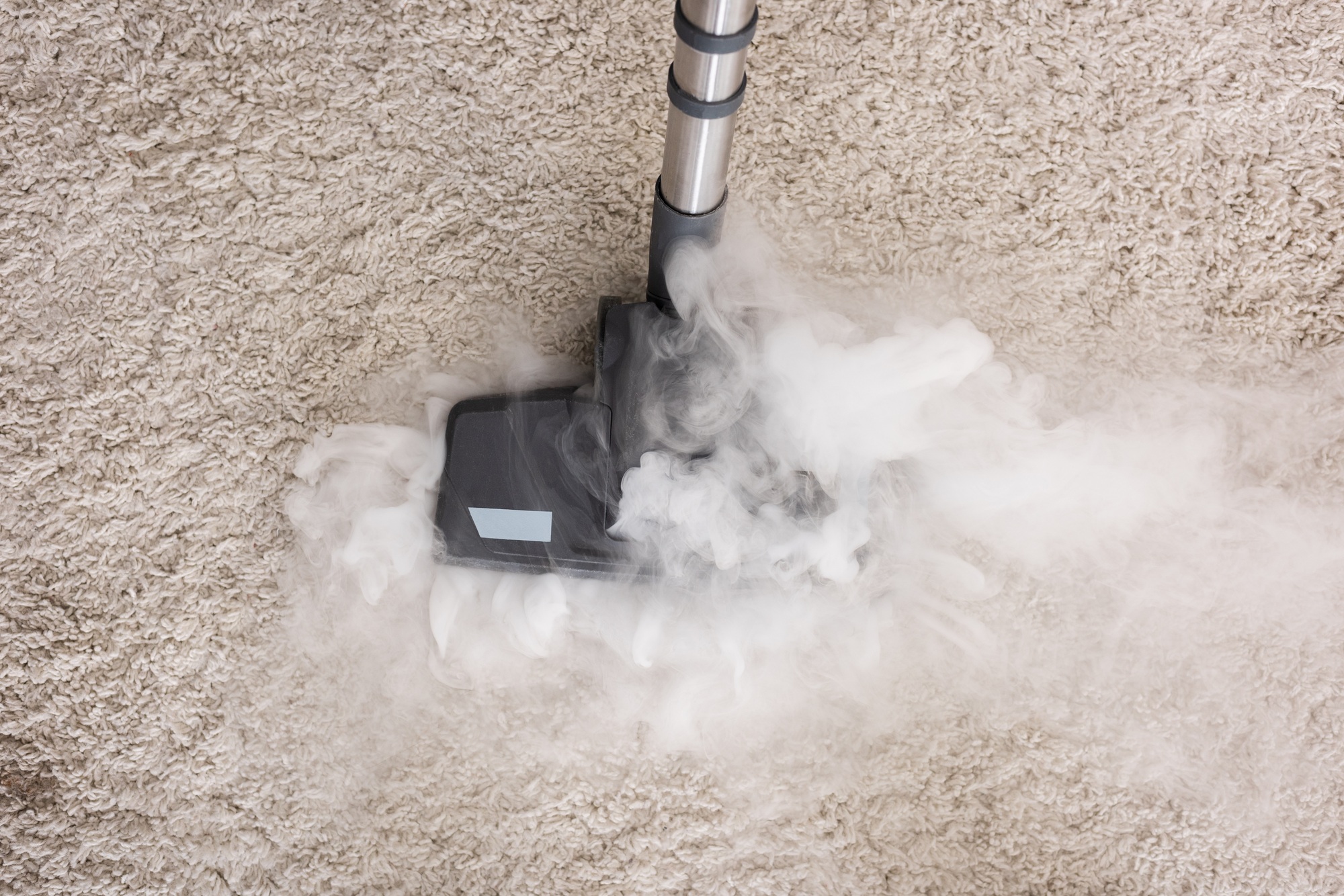
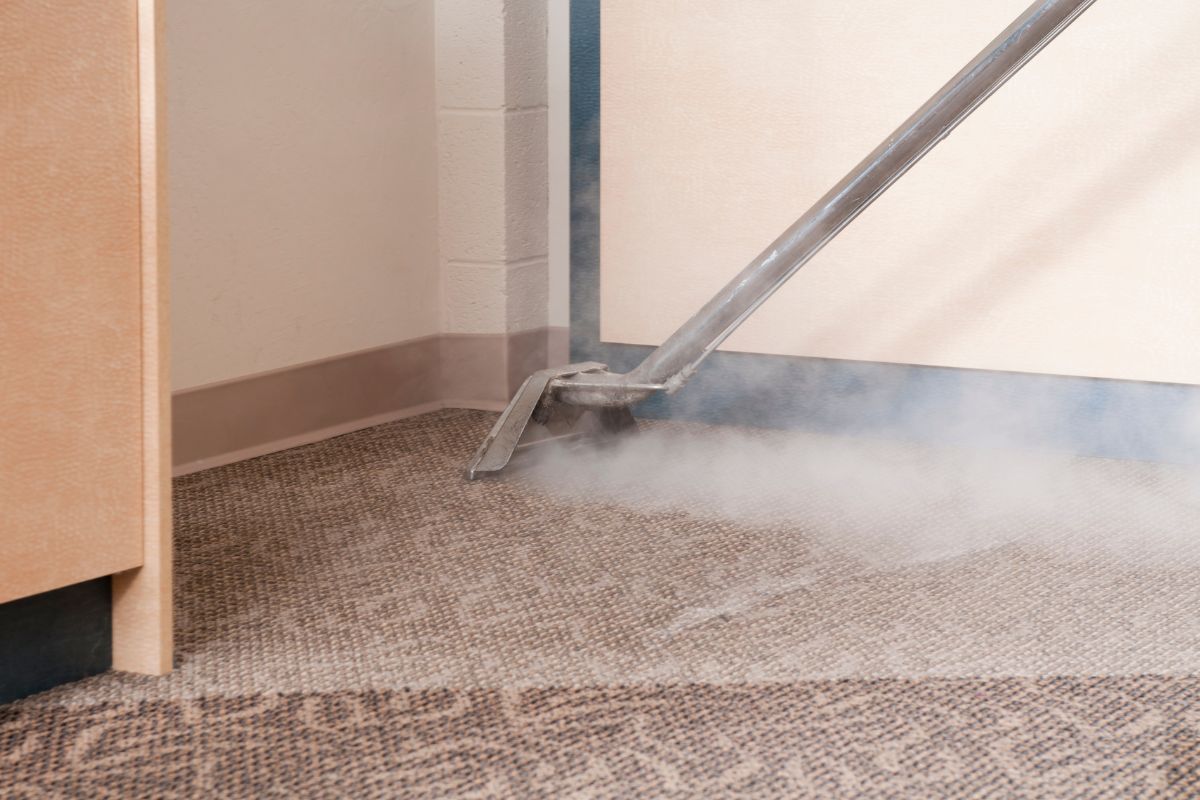
Professional drying typically means lifting the carpet at an edge and floating it so air circulates underneath as well as over, air movers directed into that gap rather than at the surface, and a dehumidifier taking the water out of the room air instead of just moving it around. Where the pad took a lot of water and sat, replacing it is often faster, cheaper and more certain than trying to dry it in place.
And the whole thing is confirmed by measurement. Moisture meters read the actual content of the carpet, the pad and the subfloor. That is the difference between “it feels dry” and “it is dry” — and it is the only version worth relying on, because the first one is exactly what fooled everyone in the first place.
The local wrinkle: slabs
Most homes across the San Gabriel Valley sit on concrete slab, which shapes this in two ways.
Water on a slab spreads sideways. It runs under walls along the slab surface into adjoining rooms, so the wet area is routinely larger than the visible one — sometimes a room or two away from where the leak happened.
A slab also holds and releases moisture slowly. In lower-lying areas — parts of Montebello and El Monte in particular — carpet over slab dries measurably slower than the regional average even without a leak. Add a water event and the timeline stretches further. If your carpet routinely takes longer to dry than you expect, that is worth knowing before anything goes wrong.
When to stop guessing and call
If water reached your carpet and any of these are true, get it measured rather than waited out:
- It sat for more than a few hours before anything was done
- The affected area is bigger than a couple of square metres
- It was grey water from an appliance, or anything worse
- A musty smell has appeared, or keeps coming back after cleaning
- The carpet is over a slab and the room feels humid days later
Call (800) 794-9241 — we answer 24 hours a day — or text a photo to (626) 260-6256. We will tell you honestly whether what you have is a dry-it-out job, a pad-replacement job, or something that does not need us at all.
If the leak just happened, start with the first hour after a water leak. For the service itself see water extraction and flood & water damage.