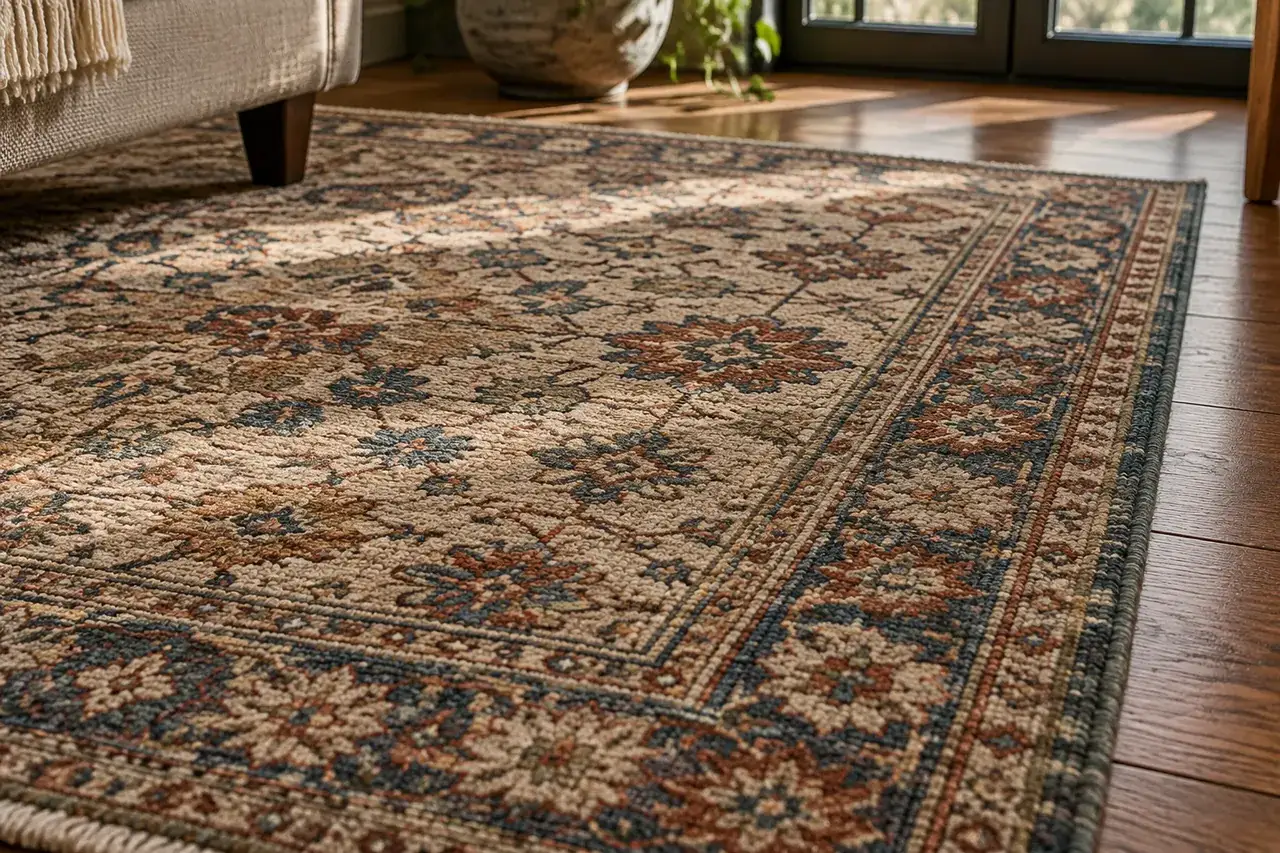
Before any sensible conversation about cleaning a rug, there is one question to answer: what is it made of? Get that wrong and everything downstream is wrong too — the water, the chemistry, the temperature, even whether the rug can be cleaned where it lies.
Here is how to work it out without specialist equipment.
The burn test, and why we are not suggesting it
The classic fiber test is to take a few strands from a hidden edge and burn them, because natural and synthetic fibers behave very differently in flame. It is genuinely diagnostic and it is what a technician may do on a loose strand.
We are not going to tell you to set fire to part of your rug. The checks below get most people to an answer without that.
Checks you can actually do
Look at the back. Turn a corner over. A hand-knotted rug shows the pattern on the reverse, with slight irregularity in the knots — the design is in the structure. A machine-made rug has a uniform mechanical backing, often with a glued-on scrim or a stiff grid. Hand-knotted almost always means wool or silk, and means proceed carefully.
Check the fringe. On a genuinely hand-knotted rug the fringe is the warp — it is the structural foundation of the rug coming out the ends. If the fringe is sewn or glued on as a decorative strip, the rug is machine-made.
Feel it, then feel it again in a lit spot. Wool has a slight natural crimp and springs back when you compress it. Silk is cool, exceptionally smooth, and has a directional sheen that changes as you move. Synthetics feel more uniform and often slightly slick.
Do the shine-direction check. Brush your hand across the pile one way and then the other. A pronounced change from light to dark — much stronger than wool gives — points to silk or, far more often, viscose.
Tap the back over a hard floor. Fold a corner back and thump it. If grit falls out, that is soil sitting at the base of the pile abrading the fibers underfoot. This tells you nothing about material but a lot about whether the rug needs attention.
The one to be careful about
Viscose — sold as art silk, faux silk, bamboo silk, banana silk, or by the name rayon — is responsible for more avoidable rug damage than anything else we encounter.
It is made from regenerated cellulose and engineered to mimic silk’s lustre, which it does convincingly enough that it is regularly sold at a distance from the truth. What it does not mimic is silk’s behaviour. Viscose loses much of its strength when wet. Plain water can leave it yellowed, stiff, matted or texture-changed, and those changes are frequently permanent.
The cruel part is that it looks expensive and delicate, so people treat a spill on it with water and a cloth — the most natural response in the world, and one of the worst things available.
If a rug has silk-like lustre but was not silk-priced, assume viscose until someone establishes otherwise.
What each fiber needs
Wool. Durable, resilient, forgiving of foot traffic — and it absorbs a great deal of water and dries slowly. It is also sensitive to high pH and to bleach. Cleaned with controlled moisture and dried flat, ideally off-site.
Cotton. Absorbent, prone to shrinkage and to browning if over-wet and dried slowly. Common in flatweaves and dhurries. Off-site as a rule.
Silk. Genuinely delicate, sensitive to alkalinity and to abrasion, and it can water-spot easily. Specialist handling, always.
Viscose. As above. Minimal moisture, carefully, by someone who knows what they have.
Synthetics — nylon, polypropylene, polyester. The most tolerant of the group. They release soil readily, handle hot water extraction well, and dry quickly. Frequently fine to clean in place.
Why we take most rugs away
Because of what is underneath them, as much as the rug itself.
A wool or cotton rug holds a lot of water. Put that much water into a rug lying on a finished wood floor and the floor is what pays for it — cupping and staining in old oak costs considerably more to remedy than the rug cleaning ever did.
Off-site, water volume, temperature, dwell time and drying are all controlled, the rug dries flat rather than in place, and your floor is never part of the equation. In places like Pasadena, where orientals over original oak are extremely common, and Encino, where large homes routinely pair fine rugs with finished wood and stone, this is not a preference — it is the only responsible way to do it.
It is the one shortcut we are not willing to take.
Before you call
Photograph three things: the front, a corner of the back, and the fringe. Text them to (626) 260-6256 or call (800) 794-9241. Those three pictures usually tell us the construction and likely fiber, which means a far more useful conversation — and occasionally the advice that a rug is not worth what cleaning it would cost.
More at area rug cleaning and oriental rug cleaning. If you are weighing cleaning against replacing, this piece covers the mistakes that most often force that decision.